
History of Istanbul Grand Bazaar: Culture, Gates & Hans 2025
Pay Once and Have Free Attractions Entry for 7 days
The Grand Bazaar, or “Kapalıçarşı” as it’s known in Turkish, is one of the oldest and largest covered markets in the world. With a history of more than five centuries, it remains a symbol of Istanbul’s cultural heritage with the charm of the past with the vibrancy of the present. This article explores the history, evolution, and architectural highlights of the Grand Bazaar.
🚗 First Time in Istanbul? Be Prepared & Carefree!
Istanbul: Private Airport Transfer with Meet and Greet 🌟 4.4 / 5 (318 reviews)
Bosphorus Dinner Cruise & Show with Private Table 🌟 4.8 / 5 (29936 reviews)
Istanbul: Full-Day Highlights Tour with Guide and Lunch 🌟 4.5 / 5 (1101 reviews)
The Origins of the Grand Bazaar: A 15th Century
Foundation Under Sultan Mehmet II
The Grand Bazaar was founded in 1461 under Sultan Mehmet II, following the Ottoman conquest of Constantinople. Initially, it started as a small, covered market known as a “bedesten,” where valuables were stored and traded, particularly textiles, gold, and spices.
Bedestens in Early Bazaar Trade
The original structure, known as the Cevahir Bedesten, became the nucleus around which the Bazaar expanded. This bedesten still exists today, and is one of the best-preserved areas within the complex.
Bedestens served as the core for commerce, primarily dealing in luxury items. Over time, additional structures were built around these bedestens, gradually expanding the market into a network of shops and streets.

Development from Bedesten to a Labyrinth of Streets
As the Ottoman Empire flourished, so did the Grand Bazaar. The initial bedesten was surrounded by shops, forming a grid of streets, and each street specialized in a particular trade — whether it be gold, silk, leather, or spices.
🕌 Discover Famous Landmarks of Istanbul
Istanbul: Topkapi Palace & Harem Museum Ticket & Audio Guide 🌟 4.2 / 5 (205 reviews)
Istanbul: Basilica Cistern Skip-the-Line Entry & Audio Guide 🌟 4.4 / 5 (318 reviews)
Istanbul: Blue Mosque & Hagia Sophia Small-Group Tour 🌟 4.4 / 5 (318 reviews)
Architecture and Layout
The Design of Bedestens
The two main bedestens, the Inner Bedesten and the Sandal Bedesten, are the oldest parts of the Bazaar. These structures were designed with thick walls and sturdy domes to protect the valuable goods within, and they remain some of the best-preserved sections of the market today.
Structure and Streets
The Bazaar is a complex network of over 60 streets, housing more than 4,000 shops. Some streets, like Kalpakçılar Caddesi (the Street of Jewelers), became famous for specific trades.

Iconic Streets and Their Specialties
- Kalpakçılar Caddesi: Known for its gold and silver jewelry.
- Çarşıkapı Sokak: Famous for carpets and textiles.
- Halıcılar Street: Known for traditional Turkish rugs.
Read More: What to Buy on Grand Bazaar, Istanbul: Souvenirs, Gifts, Carpets, Textiles, and Sweets (2025)
Don’t Miss The Best Tours and Cruises in Istanbul
The Grand Bazaar’s Roof
Exclusive Roof Tours
Recently, the Grand Bazaar introduced tours on its newly restored roof. Visitors can now explore the historic rooftop pathways, also known as the “cat’s paths”, which offer a unique point of the city and the Bosphorus.
Architectural Conservation and Future Projects
The roof restoration is part of a larger project aimed at preserving the Grand Bazaar’s architectural integrity. According to Fatih Kurtulmuş, Chairman of the Grand Bazaar, the first phase of the renovation is complete, and work continues on other parts of the structure.

Hans in the Bazaar
What Are Hans?
They are historical inns for merchants and traders. Hans are traditional inns that were integral to the Bazaar’s success. These structures gave merchants places to rest, store goods, and conduct business. Some hans, like the Zincirli Han and Büyük Valide Han, still stand today.

Free Guided Tour with Istanbul E-Pass
To get the most out of your Grand Bazaar experience, consider joining a guided tour, such as the Istanbul E-Pass. These expert guides can help you navigate the maze-like corridors, offer insights into the bazaar’s history, and provide valuable tips for bargaining with merchants.
Gates of the Grand Bazaar
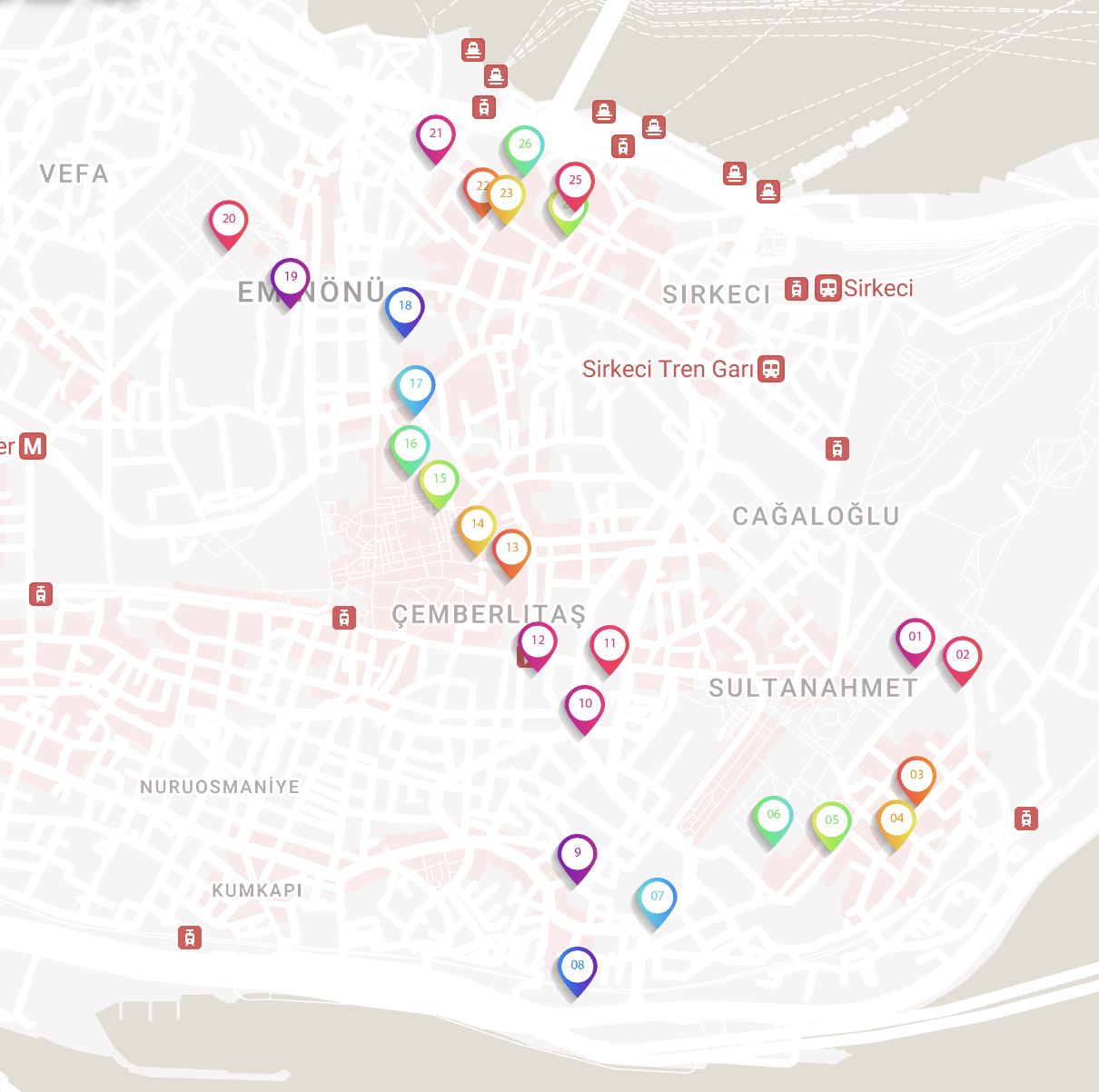
The Grand Bazaar features 22 gates, each with its own unique history and character. Some notable examples include:
Nuruosmaniye Gate
An example of Ottoman Baroque architecture, this gate leads to the luxurious Nuruosmaniye Mosque and is surrounded by high-end jewelry shops.

Beyazıt Gate
Named after the nearby Beyazıt Mosque, this gate opens onto a square teeming with bookstores, cafés, and antique shops.

Mahmutpaşa Gate
This gate is the entrance to the Mahmutpaşa Bazaar, a market area where visitors can find textiles, clothing, and accessories.
Navigation
Where is the Grand Bazaar: Getting There
Beyazıt, 34126 Fatih/İstanbul, Türkiye
Find on Maps
Multiple bus routes pass near the Bazaar. Look for buses that stop at Beyazıt Meydanı or Eminönü.
The Marmaray is a convenient way to reach the Grand Bazaar, connecting the European and Asian sides of Istanbul.
Board the Marmaray at stations like Üsküdar, Ayrılık Çeşmesi, or else.
Get off at Sirkeci: Transfer to the T1 tram heading toward Kabataş. Exit at Beyazıt-Kapalıçarşı, which is right next to the Grand Bazaar.
M2 Metro Line (Green Line)
If you are coming from areas like Taksim, Şişli, or Levent, take the M2 line.
Switch to the T1 tram line at Vezneciler station. From there, it’s just a short tram ride to Beyazıt-Kapalıçarşı. Alternatively, it’s a 10-15 minute walk from Vezneciler directly to the Bazaar.
M1A Metro Line (Red Line)
If you’re arriving from Atatürk Airport, Yenikapı, Aksaray, or nearby neighborhoods, the M1A line is ideal.
Get off at Yenikapı and transfer to the T1 tram line, heading towards Kabataş.
Exit at Beyazıt-Kapalıçarşı to reach the Grand Bazaar.
The most convenient way to reach the Grand Bazaar is by taking the tram. The T1 tram line runs through the main tourist areas of Istanbul and stops near the Bazaar. You can get off at either of the following stations:
Beyazıt-Kapalıçarşı: This is the closest stop, located right near one of the main entrances.
Çemberlitaş: A short walk from this stop will also bring you to the Grand Bazaar.
From the Asian side of Istanbul, you can take a ferry to Eminönü or Karaköy. After that, hop on the T1 tram towards Kabataş and get off at Beyazıt-Kapalıçarşı. This route lets you enjoy scenic views of the Bosphorus along the way.
Is the Grand Bazaar open all day?
Grand Bazaar Opening Hours 2025
- The Grand Bazaar is open daily from 09:00 to 19:30 except Sunday.
from 08:30 to 19:00,
closed on Sunday

Recommended Reading
For more insights into Istanbul’s rich history of bazaars, we recommend exploring the following articles on our website:
- Istanbul Enchanting Spice Culture: A Tourist’s Guide to Aromatic Markets and Turkish Flavors
- Sensational Spice Bazaar in Istanbul: History, Things to Buy and How to Get
- Full Guide about Arasta Bazaar in Istanbul: Things to Do & Buy
- Best Fish Markets in Istanbul: A Seafood Lover’s Paradise
- Where to Eat on Grand Bazaar: Cafes, Restaurants, Doner, Drinks, and Sweets
Visitor Information
-
💵
Entrance Fee: Free
-
⌛
Opening Hours: from 9:00 am to 7:00 pm
-
⛔
Closed: Sunday
-
📍
Location: Beyazıt, 34126 Fatih/İstanbul, Türkiye
Don’t Miss The Best Tours and Cruises in Istanbul
Old City Route – Istanbul
$9.99
★★★★★
A step-by-step guide to uncovering Istanbul’s hidden gems beyond Sultanahmet. Access the route via Google Maps and a handy PDF guide
Similar Posts
Beyoglu and Taksim: Top Things to Do & See, Cafes, Museums, and Hotels (Istanbul, 2024)
Save up to 70% with Istanbul E-Pass Pay Once and Have Free Attractions Entry for 7 days Save over 50% Welcome to Beyoglu, Istanbul’s lively district where modernity meets tradition. Located on the European side of Istanbul, Beyoglu is a vibrant neighborhood that buzzes with energy and is home to some of the city’s best…
Istanbul Fashion Boutiques: Trending Turkish Brands and Shops (2025)
Save up to 70% with Istanbul E-Pass Pay Once and Have Free Attractions Entry for 7 days Save over 50% Istanbul, the city where East meets West, has a vibrant fashion scene that reflects its rich cultural history. Istanbul fashion boutiques are home to various clothing styles, from traditional Turkish designs to contemporary streetwear. In…
Churches in Istanbul: A Journey Through Faith and History
Save up to 70% with Istanbul E-Pass Pay Once and Have Free Attractions Entry for 7 days Save over 50% Istanbul, once known as Constantinople, has a long and complex history that spans centuries and empires. This vibrant city is home to a diverse range of religious sites, including many beautiful and historic churches that…
Thrift Shopping: A Guide to Vintage Clothes Shops in Istanbul
Save up to 70% with Istanbul E-Pass Pay Once and Have Free Attractions Entry for 7 days Save over 50% Istanbul, a city with a rich history and a vibrant culture, is the perfect destination for vintage clothing enthusiasts. With its unique blend of East and West, the city boasts a treasure trove of second-hand…

Atasehir in Istanbul: Top Things to Do, Sights, Hotels, Shopping, Where & How to Get? (2025)
Save up to 70% with Istanbul E-Pass Pay Once and Have Free Attractions Entry for 7 days Save over 50% Welcome to Atasehir, the Asian side of Istanbul where modernity meets traditional Turkish culture. Atasehir is one of the most sought-after districts in Istanbul, perfect for those seeking a good quality of living and investing…
Spice (Egyptian) Bazaar: What to Buy & Hours | Istanbul 2025
Save up to 70% with Istanbul E-Pass Pay Once and Have Free Attractions Entry for 7 days Save over 50% The Spice Bazaar (Mısır Çarşısı), also known as the Egyptian Bazaar, is one of Istanbul’s most famous marketplaces, dating back to the 17th century. Constructed in the 1660s as part of the New Mosque complex,…